
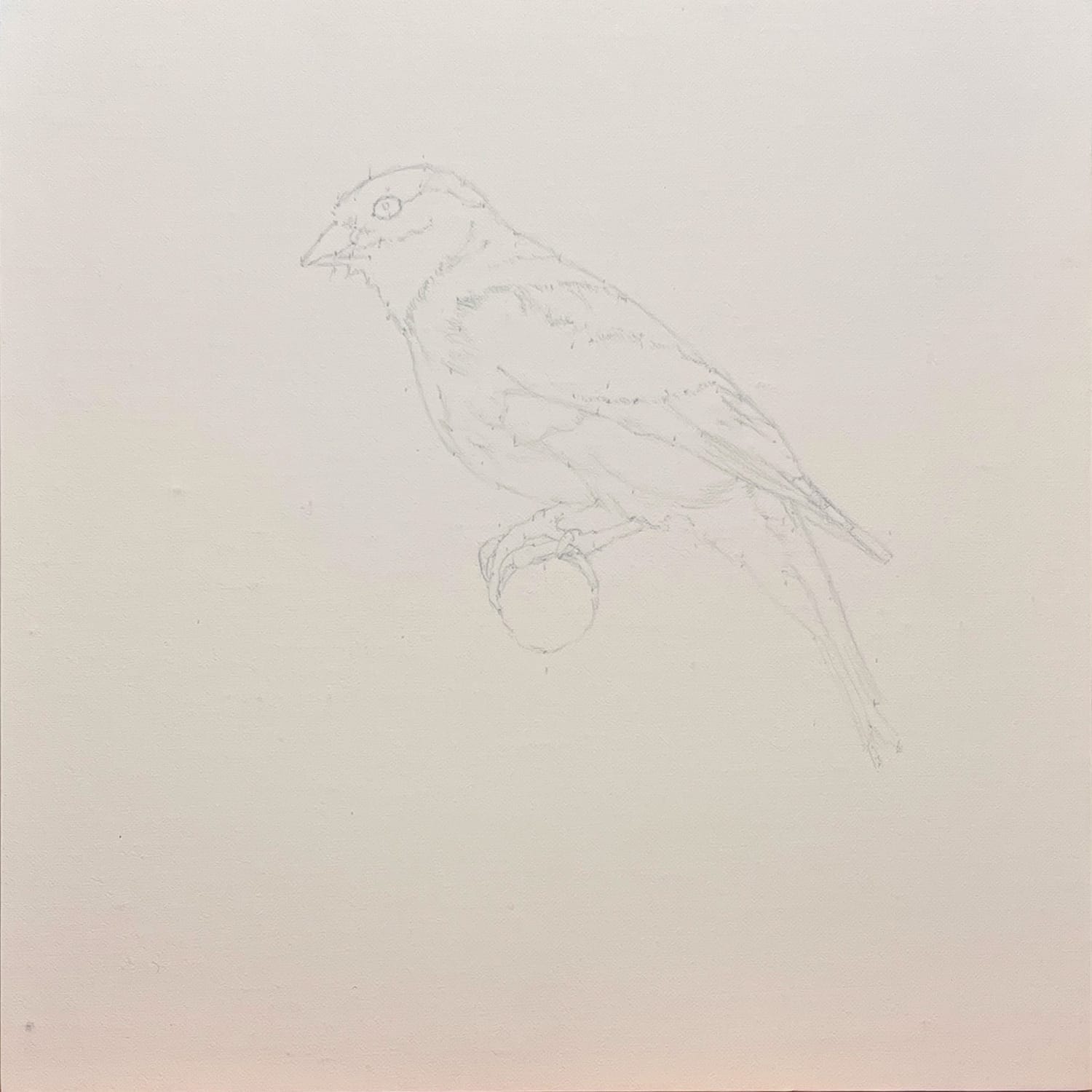
The initial sketch of my visitor, Élian, an American Goldfinch
A story of Bran and Keziah
The Red-Tail at the Threshold
Painter’s annotation: I have always believed the studio is a place of invitation. I never imagined it could also be a place of aftermath.
Chapter 1: After the Kill
It was early, and I was late.
Light had already moved past its first reach. The shadows were no longer long and silver but settling into shape, wide at the baseboards, warm at the corners. I unlocked the studio door and stepped inside—quiet, as always, though the hinge betrayed me with a soft groan.
And then, everything stopped.
She was there. Not in flight. Not perched. On the floor.
Wings half-raised, shoulders hunched. Her back to me.
A Red-Tailed Hawk. Female. Massive. Still in her winter coat—dark feathered trousers, streaked belly band, tail not yet fully flushed but unmistakably rust at the core. Keziah. I didn’t know her name then — that came later — like a stone uncovered beneath a long-unmoved leaf. Sharp, mature, inevitable.
She turned just her head. Her eyes found mine. The moment was longer than it should have been. She didn’t spook. She didn’t flee. She marked me.
Then I saw what was beneath her. The pigeon.
Feathers loose around the scene like unspoken words. Blood fresh — not a pool, but a stain— clean at the edges, still warm. His body was still curved around itself, as if not yet willing to unspool into absence.
Bran.
I had seen him before, in the park. Never near, but often near enough. Perched on the rail near the downspout. Bathing on the rooftop ledge. Watching, not begging. A quiet life.
And now — this.
Keziah stood between him and me, as if afraid I might steal her meal. There was nothing savage about her posture. Perhaps she had fed enough. Not defiant. Present.
As though she knew she’d crossed some line. Not morally—birds don’t do morality—but spatially. She had brought the wild struggle into my studio. The studio had never been sacred. Creating is too messy for sacred. But it had always been neutral.
Not that morning, though.
We stayed still. I didn’t step forward or look away. She let the silence stretch a moment longer, then turned, graceful and inevitable, and with two slow beats of her wings, she lifted to the window and out. One feather fell behind her as she vanished through the upper transom.
I knelt by Bran. His eye was half-closed, body still holding warmth. A twitch. Out of respect I didn’t touch him. out of respect.
There is no clean way to meet death. But there is a way to not meddle with it.
I moved back. Sat on my stool. Waited. The studio smelled of raw oils and glue.
After a time, I retrieved an old piece of cloth from beneath the sink. Soft linen. One I’d used for years to cradle small frames in storage. Returned, folded Bran gently inside. Carried him out, into the park, and laid him down beneath the elderberry bush that grows crooked along the fence line. I whispered nothing, because what can one say?
One by one, a few of his neck feathers drifted, caught on the updraft that always spins off Lake Michigan, the kind of wind pigeons know. It was a signal, though I couldn’t read it.
But the others did.
Later that afternoon, I noticed a change. The usual cluster of pigeons that gathered on the western roof ledges was gone. Scattered. Not in panic, just… not there.
Bran had not been loud. But now that he was gone, the silence he left behind had a shape. A soft, wary vacancy in the park sky.
When I came back in, the studio had changed.
The pegs were still there. The unfinished canvas still leaned half-covered. But the space felt wider. Not ruined. Not haunted. Just... realer than it had been.
I stood for a long time in the center of the floor.
And then I swept the fallen feathers into a shallow ceramic bowl—the same one I use to clean pigment stones. I didn’t clean it.
I left it there.
A kind of offering.
Not to Keziah. Not to Bran.
To the truth.
Chapter 2: What Bran Knew
Painter’s annotation: Not every bird who appears here seeks to be seen. Some carry a history too common to register as beauty—until it’s gone. And then its absence leaves a shape.
Bran had been here before.
Not as a visitor, like Élian. Not as a bold interloper like the Raven. Just as presence—an edge of motion caught through the window, a flutter against the side wall, a shadow sliding between rooflines.
I had seen him many mornings on the rail behind the gutterpipe, gray flanked and watchful. Never still for long, but not panicked either. He came for the corn I scattered by the garden fence, or for the flat warmth of the rooftop after rain.
I never thought to paint him.
That’s the truth. Not out of contempt. But because pigeons live so constantly at the edge of human life that they become part of the background noise. Common. Patterned. Assumed.
But I see now that he had been watching.
Not me. Not directly. But the room. The other birds. The slow shift in the world of feathers around him.
He had seen Élian come and go.
He had watched the Rosy Finches arrive, separately, and depart in the same hour.
He had seen the Zebra Finch perch on the broken peg, quiet and curious.
He knew the studio had begun to change.
He never came close. He didn’t inspect the pegs. He didn’t leave a feather or hover at the window.
But he lingered.
Longer than he used to. He flew slower past the eaves. He sat a bit heavier on the fence.
That’s how I know he understood something was happening. Maybe not what. But that. And that was enough.
They say pigeons are creatures of pattern—and they are. But patterns see things we don’t. They register changes in rhythm, light, smell, breath. And they adjust.
Bran had adjusted.
And then, Keziah came.
When I lifted his body, I noticed his wings first—soft gray primaries, darker on the edge, like dusk-colored ink. His neck had iridescence I’d never seen in the moment. Oil green, violet. Not showy. Just there.
I saved three of the feathers.
One from each wing. One from the neck.
Not to keep him. Not to mourn.
To paint him.
It will not be a portrait.
It will not show his eyes or the moment of his death or even Keziah, though she made it real.
But he will be in it. In the brushwork. In the feather shapes. In the gesture of a wing folding around nothing in particular. In the middle distance behind a finch or the shadow below a crow.
He will be there.
Because now I know I had been watching without seeing.
And that is something I don’t intend to repeat.
Chapter 3: The Hawk Remembers Wind
Painter’s annotation: Some birds see from above, but remember from below. Their memory isn't in years—it’s in thermals, in the pressure of air against the chest, in hunger that sharpens into clarity.
She didn’t return the next day.
Or the day after.
But I could feel her passing.
A shift in the sparrow flocks outside. The way the starlings pressed closer together on the wire before dark. The silence of the park’s west slope, usually rustling with doves at dusk.
Keziah had not vanished. She had widened her circle.
Red-Tailed Hawks do not need permission to move across territory. But they remember where the heat lifts, where the rooftops echo, where wind splits around spires and leaves space for a glide.
I stood at the window one morning, coffee in hand, when I saw her. Not close. Not low. A dim crescent against the sky, wings extended flat, tail fanned.
Turning without rush.
She made no pass toward the studio. No dive. Just a long, patient spiral above the cottonwoods near the park’s edge.
That was when I began to mix new blacks.
Not the dense, opaque blacks that swallow light—but open ones, made from Ivory Black and Ultramarine, from Burnt Umber and a breath of Violet. Blacks that let air through.
Because I didn’t want to trap her in shadow.
I wanted to understand the space she moved through.
I sketched loosely—circles, beak angles, shoulders, weight. None of it right. Not yet. But something in me needed to start preparing. For what, I didn’t know. She had not asked for a place here.
Still, I added a new peg. Higher than the rest. Near the upper molding. A perch with no easy reach, barely visible unless you craned your neck upward. No bird had landed on it. It wasn’t for show.
It was for possibility.
She returned on the sixth day.
Not inside.
Not even close.
She perched across the street, on the old lamp post that only lights in fog.
A line of pigeons flew past, and I saw them tilt—subtly, in unison—as they passed overhead. Adjusting their path not out of panic, but respect. Bran’s kin, maybe.
And Keziah didn’t move.
She was watching the studio.
Not the window. Not the open ledge. Just the shape of the place. As if weighing it. Measuring its usefulness.
And maybe, its trespass.
She knew what it meant to have brought death indoors.
But she didn’t regret it.
Predators don’t regret. They remember. And they learn.
She was learning me now.
The way my shadow moved behind linen.
The way the brush paused mid-stroke when the light shifted.
The silence I kept since she’d been.
She stayed for nearly an hour that day.
I didn't paint.
I didn’t open the window.
I sat, quietly, between canvas and color, and I watched the air remember her weight.
When she left, I didn’t move.
The studio no longer belonged only to me.
Chapter 4: Her Place on the Wall
Painter’s annotation: Some birds never touch ground unless necessary. Their presence is not in the landing, but in the effect of their nearness.
I didn’t see her for four more days.
But signs of her passed through the studio in other ways.
Twice I found small bones just beyond the fence—clean, set down with care, not scattered by fox or storm.
Once, the wind changed too suddenly. A downdraft lifted the corner of the canvas tarp and flipped a page from my sketchbook. Nothing else stirred. No door opened. But the shift was unmistakable. She had passed above.
Then one morning I found the high peg splintered.
Not broken. Not torn from the wall.
Cracked. A single hairline fissure across the upper edge, and a sharp groove just to the side, like a talon had tested it—not for balance, but for purpose.
There were no other marks on the floor. No feathers. No clawing. Just that one soft wound.
She hadn’t landed.
But she had touched it.
I stood on the stool and ran my fingers across the woodgrain. Still warm, I could’ve sworn. Or maybe I just imagined heat from her presence.
Either way, I carved a new peg.
Thicker, with a broader perch, smoothed by sandpaper and brushed with a mix of wax and graphite. I placed it higher than the first—closer to the crown molding, tucked in the studio’s far right corner.
Not symbolic. Practical.
She would not pose where others did.
She would not share the wall with Élian, or the Rosy Finches, or the wide-eyed little Finch who waited on the broken peg.
Keziah’s place would be above.
Not to look down on them.
But because she carried something they did not: the weight of what must be taken to stay alive.
Bran’s feathers still sat in the bowl by the pigment stones. I hadn’t moved them.
Some mornings, before painting, I walked to the park.
Pigeons no longer gathered in the usual spot.
They had dispersed—wider flight paths, more caution on the rooflines. But I could tell when one had known him. The way they tilted their heads at the bush where I buried him. How they flinched not from movement, but from memory.
One pigeon—a slate-colored one with a scarred wing—landed briefly on my fence and looked in.
He didn’t stay.
But he saw the wall.
And then he flew.
Back in the studio, I started sketching talons. Not claws. Not curled horror. Just talons—resting, extended, folded around imagined branches.
Then came the eyes.
Not blank circles, but weight-bearing shapes. Eyes that had watched a rodent scurry, or a wind shift, or a boy lift a slingshot. Eyes that knew what they saw.
But still, she didn’t come.
Not fully.
She remained at the threshold.
That was enough.
Because that meant she was choosing.
And in that choosing, the wall grew more real.
Chapter 5: Hunger Is Not a Shame
Painter’s annotation: There is no shame in hunger. Only in forgetting what it means to need, to take, to feed a life with another’s.
When she entered again, it was not like before.
There was no kill. No blood. No pigeon.
Just Keziah—gliding through the open top sash like shadow made wing, soundless but whole.
She did not land on the peg.
She landed on the canvas.
It was unprimed linen, stretched but unfinished. Meant for a new portrait. A quiet wren, maybe, or the Zebra Finch, who had returned once or twice and waited in a hush so soft I could barely hear my own brushes.
Keziah landed on the lower edge, near the brace, and held herself still—one wing slightly lifted for balance.
I didn’t move.
I sat with her.
Not sketching. Not recording. Just present.
I could see the muscles along her breastplate rise and fall. I could see the scar where one feather came in sideways. I could see the tips of her talons shift slightly as she adjusted for weight.
I realized then—she hadn’t come to pose.
She’d come to rest.
I thought of Bran.
Not as prey. Not as victim. As participant.
He had made her hunger visible.
And that meant he, too, was now part of the wall. Not painted, not chosen, but recorded.
That evening, after she left, I reached for a new panel.
Not linen. Wood.
I rubbed it with rabbit skin glue, then sanded it gently. I didn’t know what the painting would become yet. But I knew it would hold both of them. Not as allegory. Not as predator and prey.
As real creatures, caught in the impossible tension of life together.
One with a gaze too quiet to be noticed. One with a gaze too sharp to be ignored.
I used one of Bran’s neck feathers as a brush that night.
It left almost no mark.
But it changed the paint.
And I left it like that.
Because that, too, is part of the truth: hunger doesn’t erase what came before. It builds on it.
And shame has no place in that.
Chapter 6: The Pigeons Speak Softly Now
Painter’s annotation: After a death, the birds don't sing louder. They sing less. What remains becomes a kind of code.
The pigeons returned gradually.
Not in flocks.
In threes. In pairs. Once, a single bird landed on the rail and stood for twenty-eight minutes without moving.
They no longer bathed in the gutter water.
They no longer cooed in morning clusters by the east wall.
Now, they watched.
And when they flew, they did so together—not with the casual dispersal of a city flock, but with coordinated lift. A rise. A pause in midair. Then descent, never all at once.
The space above the elderberry bush became a silent axis.
They remembered.
Bran was not a prince. He was not a leader. But he was the one who noticed first.
And the others—who might never have understood what the studio meant—now moved around it with a gentler rhythm.
I once heard four of them pass above the open window. Their wings made a quieter sound than before. As if even air was being held with more care.
Keziah came less often now.
But her effect remained.
The finches who once perched with the light bravado of mischief now held their poses longer. As though understanding they, too, were choosing to be seen.
Even the Raven, Lutch, who came and went like a breeze through a barn door, stood still one afternoon when he saw Bran’s bowl beside the easel.
He tilted his head once, gave a low click in his throat, and left without a word.
I didn’t paint that day.
I sat by the window and watched the sky shift from pearl to bruised lilac. I listened to the pigeons murmur low and steady on the rooftop. A language of absence.
Soft.
Measured.
They weren’t afraid anymore.
They had adjusted.
Not because fear faded—but because memory had taken root.
And now, every painting that begins on that far wall starts with a stillness.
The kind that doesn’t have a name.
But might sound, if it had a voice, like the way a pigeon settles beside another without asking permission.
Chapter 7: The Red-Tail Returns in Silence
Painter’s annotation: Not every bird who returns wishes to be seen. Some come back simply to confirm the shape of the world.
She came back in snow.
Not the thick snow of storms, but the drifting kind, where each flake seems to fall alone, as if thinking over its decision before touching ground.
Keziah circled once, twice, and landed not on the peg I built for her—but on the window frame itself. The top sash. Bare wood, grain rising from old moisture. She faced the room, not the sky.
I had been painting a thrush.
A new subject, skittish. All breast and breath and sudden decisions. She had flown off the sitting wall not thirty seconds earlier, as though sensing what was about to happen.
Keziah watched me.
She did not glance at the canvases, the pigments
, the pegs. She didn’t need to. She had already seen them.
She had seen the bowl of feathers—Bran’s bowl—still undisturbed on the lower shelf. She had seen the high peg left empty, never reassigned. She had seen the new panel I had begun to shape in soft umber and green-gray—no subjects yet, just mass and gesture.
Her chest rose once.
Then she tucked one leg beneath her, feathers settling over claw, and exhaled.
The room felt no colder for her presence, though snow collected now on the outside sill.
I didn’t move.
Not out of reverence. Out of understanding.
She was not here to pose.
She was not here to be painted.
She was here because she could be.
That’s all.
The pigeons remained silent on the wires across the street. Their heads turned toward her, then slightly away. No alarm. Only acknowledgement.
A squirrel chirred somewhere in the alley.
A crow passed overhead but did not speak.
She stayed for seven minutes.
Long enough for light to shift against the southern wall. Long enough for the thin shadow of her wings to stretch—once—across the floor, over the low peg, past the stool.
Then she was gone.
No flap. No rise. Just absence.
As if the room had imagined her.
But it hadn’t.
She left one mark—a single print of her talon in the snow on the outer sash. It melted within an hour.
I didn’t trace it. I didn’t photograph it.
I simply looked.
And let it vanish.
Coda: The Peg Remains
Painter’s annotation: Some pegs will never hold a pose. That doesn’t mean they aren’t part of the portrait.
The high peg remains untouched.
Even now.
Birds glance at it—some finches, once even the Zebra Finch—but none attempt it.
It is hers.
Not by decree.
By memory.
It is a place of arrival and retreat, a threshold without claim.
Bran is buried still beneath the elderberry bush. The pigeons have resumed their songs, softened forever by the echo of feathers once lifted into cold wind.
I have not painted Keziah’s portrait.
But I have begun the work.
It is not of her face. Not of her eye.
It is of what the studio became after she passed through it.
It is of hunger and presence.
It is of a bowl of feathers left undisturbed.
It is of a peg too high for most birds to reach—left waiting, untouched, and real.
45% OFF DECEMBER SALE | Discount Code DEC45 Has Been Applied To Your Current Visit

Bird Portrait Collections
RAVENS & CROWS
RAPTORS
Contact
Have a question, an issue with your order, or just want to say hello? Email me ...
Read about new Avian Chronicles paintings and prints by connecting via email and social media.

Follow Me On Instagram

Follow Me On FaceBook

All Content © Copyright 2026