
Avian Chronicles Collection: Élian, the First to Ask
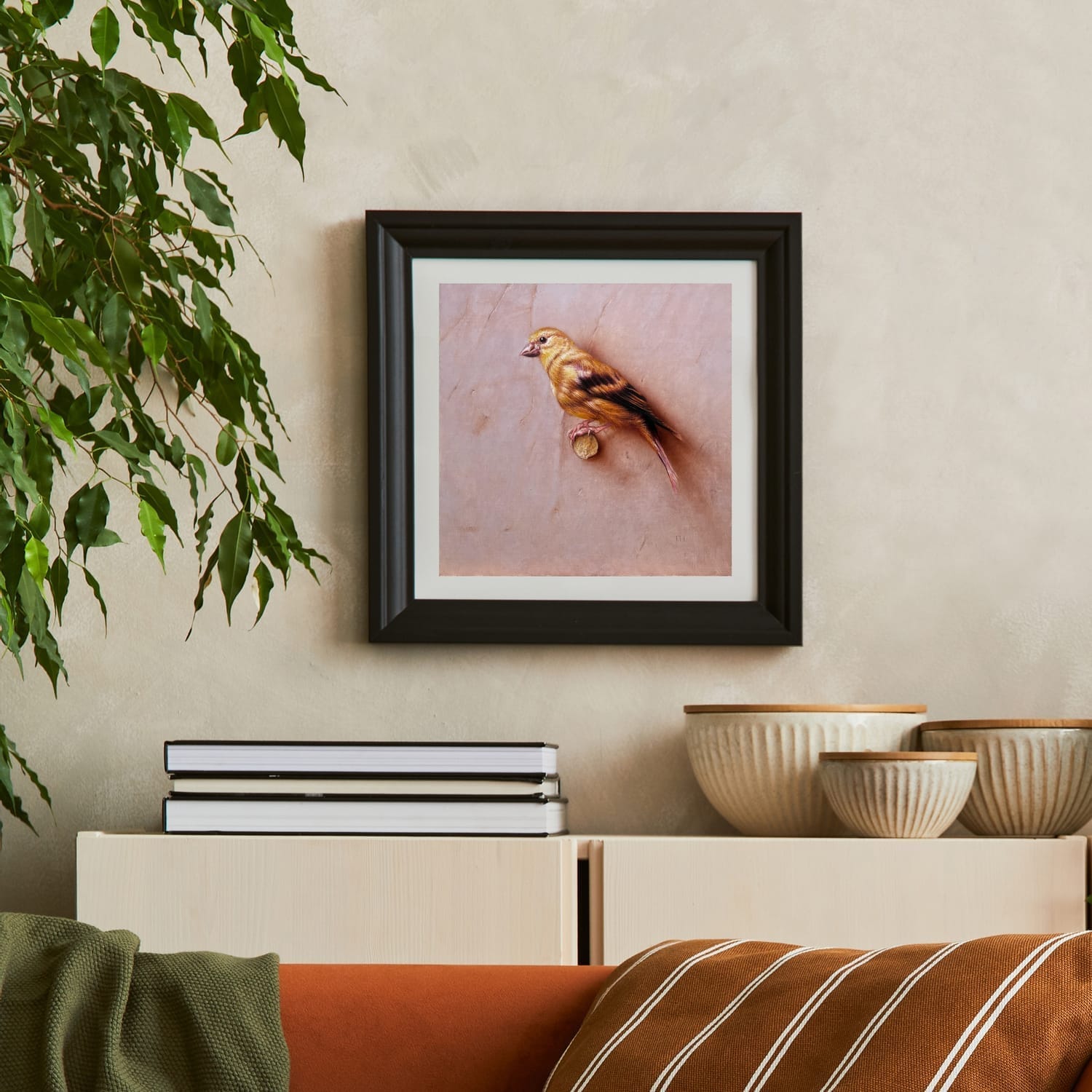
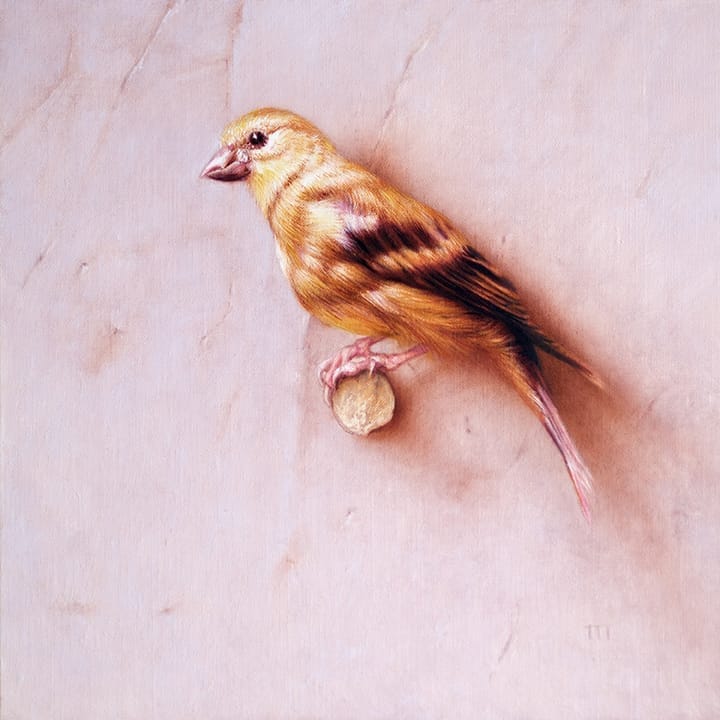
Before the rosy finches, before Maeven’s shadow glanced the beams, before the Horned One taught me to paint sorrow without remorse — there was Elian, the American Goldfinch.
He was the first.
I hadn’t even finished moving in. My studio still smelled of paint and dust. Light came in too clean through the high west windows, landing the outline of the outside tree sharply on the floorboards. The shadow barely moved, unless I looked away. There were no pegs on the sitting wall yet — no sitting wall at all, only a shelf beneath the windows where a few rusted screws clung limply. I was pretending to work on a still life, though my hand had wandered from subject to subject: an apple, a bowl, a draped cloth… but in the margins, small birds.
The birds. Ah me. Mostly imagined. Mostly poorly drawn.
One was worse than the rest. Too angular. Too bright. I had tried to make the yellow believable, but it looked artificial no matter what I mixed. Cadmium was too loud. Lemon was piercing. Even ochre, softened with white, felt insincere. I abandoned the bird mid-wing and turned back to the apple, or maybe to... what? Was it a reverie?
What I do remember is this:
A shadow passed through the window’s lower square. I didn’t look up. I assumed it was a inconsequential, maybe one of the crows who nested near the University's bell tower.
But then — soft as the fall of a single raindrop — he appeared.
An American Goldfinch, full male, in full color. Though it was neither the season for such a coat nor the hour for visitors.
He did not land on the shelf.
He hovered.
Wings taut, just above the wood where others would later perch without hesitation, he hovered like a question. Not for me, exactly. A question for the room. For the act of looking itself.
I said nothing.
He held himself there a moment longer — long enough to make it strange — then dropped lightly to the far end of the windowsill, nearer the lemon tree than the easel. He didn’t approach the perch, didn’t move toward the canvas, didn’t glance at me.
Instead, he faced the back wall. There hung one of the only framed prints I own: a Bronzino portrait, a noble Italian woman in red velvet, unsmiling and perfect. It seemed almost an accidental placement. A placeholder for beauty, perhaps, or for seriousness. Elian certainly was taking her seriously.
He stared.
I don’t mean glanced. I mean stared — chest lifted, body held still, the kind of stillness birds usually reserve for windstorms.
Then he turned, very slightly, and gave a single, sharp tick.
That was it. No chirp, no flutter. Just a sound, like judgment passed on a color too raw.
He stayed long enough to mark the moment indelibly. Then he was gone. I didn’t see him again for several days.
But I thought of him. Of the way he had looked not at me, but at the Bronzino. And of the unfinished yellow bird on my easel — bright, not quite true.
When he returned, he did not announce himself. I simply looked up from my palette, and there he was again — this time on the shelf. Perched. Silent. Watching.
And I, fool that I was, picked up my brush.
He did not move. He didn’t preen, didn’t blink. But somehow I knew not to sketch the same pose I had been working on before. This wasn’t repetition, or even continuation. It was something fresh.
I started a new composition. Slowly. Trying to earn the moment.
I got as far as the first pass of yellow — Cadmium Light, cut with a trace of white — and he lifted his wings. Just enough to show disapproval. Not flight. Not yet. Just... warning.
I scraped the color off. He stayed. That’s how the serious work began.
He became a regular presence — not daily, not predictable, but inevitable. Sometimes hovering, sometimes still. Sometimes a tick, sometimes just breath. I began calling him the Witness, though never aloud. Only in the margins of my sketchbooks.
The Witness came today. Looked at the Naples mix. Waited. Left.
Mixed Yellow Lake too early. He turned away. Ticked once. Then again. The second tick means “closer,” I think.
I learned that he disliked haste. That he was not watching for likeness, but for truth. And that he would only let himself be painted when the yellow was… ready. Ripened was the word that finally came to me.
Once, I laid down Cadmium Yellow Deep straight from the tube —bright and loud and proud — and he flew out so fast he startled a brush from the jar. He didn’t come back for eleven days.
I wrote the Munsell color number (7.5YR 6/14) in charcoal on the window frame. A small act of apology.
When he returned, he did something I didn’t expect.
He stepped to the edge of the palette itself — first time — and tapped a dried flake of pigment with his beak. It was Cadmium Yellow Medium, touched with Burnt Umber. A deep, chromatic yellow-red that was almost yellow. I had used it in an underpainting the day before.
He tapped it once. Then looked at me.
That, I understood, was his yellow. Not the trumpet-blast of first bloom, of highlighted feathers, but the deep note of something settled beneath them. The yellow of goldenrod at its peak, of sunflower heads heavy with seed, of thistle husks curling. It had waited. And so had he.
After that, the real painting began.
Not in full, not all at once. Just fragments at first. Ground. Underpainting. Glazes. A shadow feather here, a glint there. He guided it — not by word or movement, but by presence. When the value was wrong, he turned away. When I hesitated at the right moment, he stayed.
And then — after weeks of these small, exact visitations — he sang.
It was a first. Before, there was nary a chirp.
But that day — near three, the sunlight falling full across the varnish jars — he stood on the open drawer where I keep yellow pigments, and he sang. A single warble. Fragile and winding, like water through dry grass.
He dropped something onto my palette. A paint chip of dried Yellow Lake — curled, almost beautiful.
Then he sang again.
And I understood. Or thought I did.
He had not waited to be painted. He had waited to see himself —rightly — in something on the way to becoming true. That yellow wasn’t a color. It was an arrival. It had taken time to know itself. And now, he saw it.
The portrait was the truth that followed — he did not sit for it in any traditional sense. But it was his. I titled it: Late Gold, Before Wind.
And just before he left — wings tilted to the south, eye sharp, still glinting with summer — he looked at me.
And said one word.
“Elian.”
Soft. Almost not there. But I heard it.
Then he flew.
Not fast. Not theatrically. Just... enough. Enough to say: this is where it ends.
He has not returned since. Or if he has, it was without notice.
Sometimes I hear ticking, faint and dry, like a seed casing spinning in the breeze. But no wingbeat. No song.
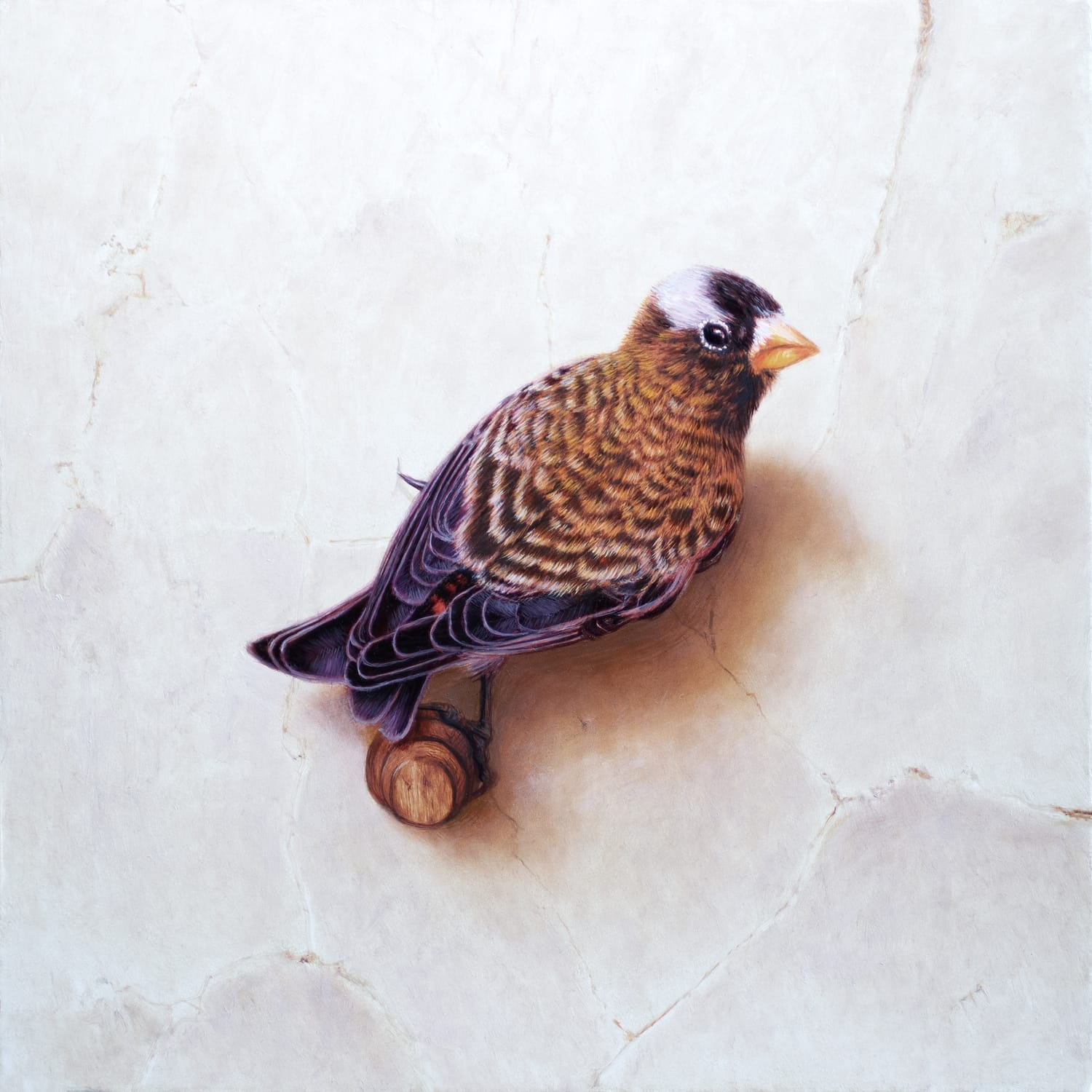
Still, I wait for another visit from Élian, and I never lay out my yellows too soon. Later, other birds were to come: Rosy Finches, Barn Owls, Great and other Owls, Ravens (who bring presents) and once a Hawk who ate my favorite pigeon, leaving nothing behind but a small pile of iridescent feathers.


At Pratt in 1972. Yes, I was a hippy.
My Promise to You
Original Paintings and Prints | Since 1971
Free Shipping | US Domestic
Professional Printing | Studio Quality
100% Happiness Guarantee


Kind words from verified reviewers:

Richard is one of the very finest painters I have ever known. His process stands as an inspiration to many — uncompromising and endlessly creative. He breaks new ground, over and over. He is amazing.
BD
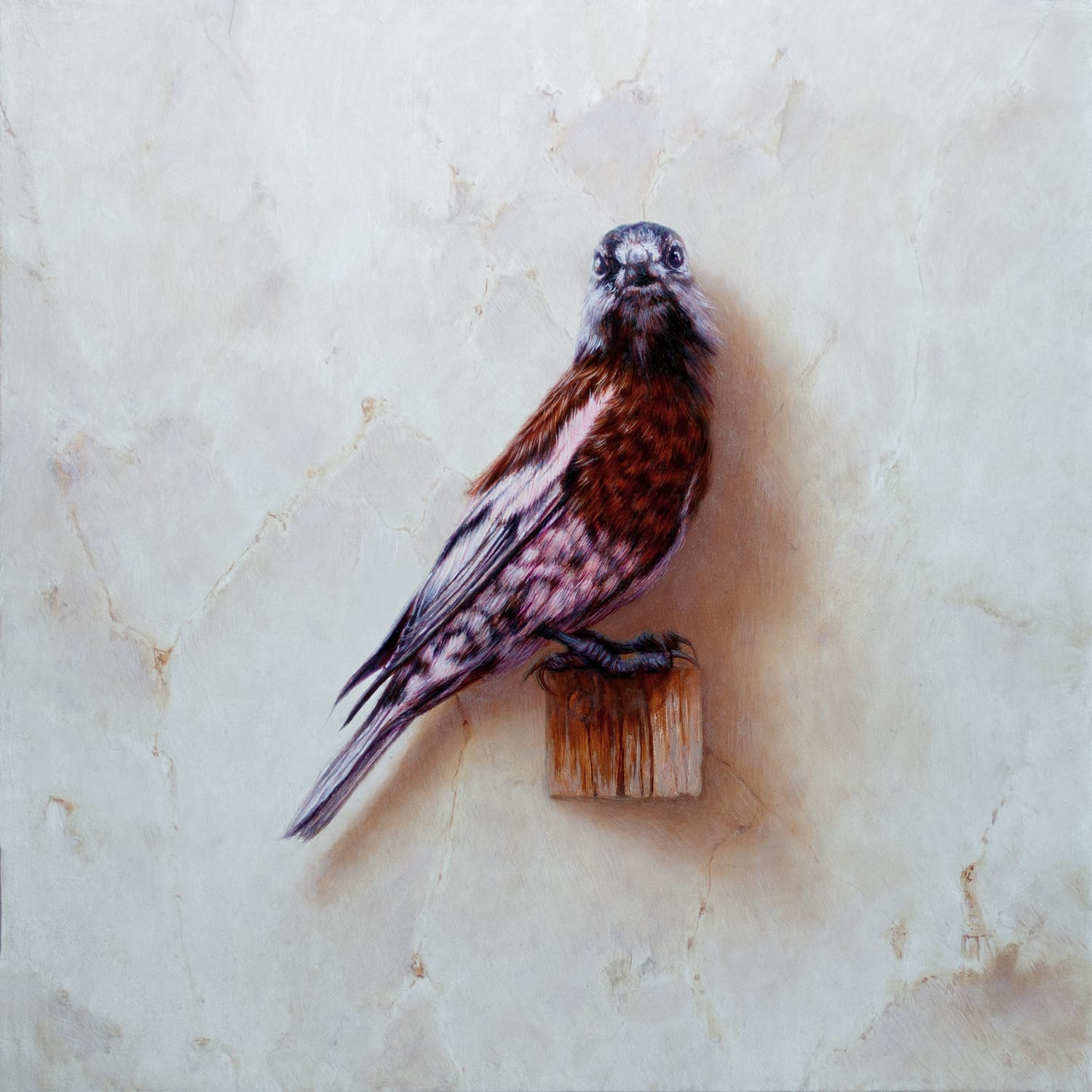
They are gorgeous. The rich color of her plumage is stunning. I love the finished finch and am so intrigued by the Gray-crowned Rosy Finch you’ve started. The background is fascinating and different.
DW
I have had the great fortune of seeing your work in person at Principle Gallery. Coming face-to-face with your American Goldfinch for the first time brought me to tears. The juxtaposition of strength and vulnerability resonated in a visceral way. It spoke to me of the human condition, of our fragile footsteps as we make our collective way through life, yet those same footsteps can also wreak havoc. I saw the painting as a poignant depiction the yin-yang of life.
MD
Richard , thank you so much! The finch is a treat for the eyes. I love the marble background! I love your painting. It’s in my office and makes me SO HAPPY.
MB.
Trusted ★★★★★ | 270+ Birds Shipped
FREE SHIPPING | Satisfaction Guaranteed
Professional Printing | Museum Quality

Bird Portrait Collections
Contact
Have a question, an issue with materials, or just want to say hello?
Read the new Avian Chronicles by staying connected via my emails and social media

Follow Me On Instagram

Follow Me On FaceBook

All Content © Copyright 2026

Read the Next Three Chapters of Sima & Élio’s Journey
Step into the hush of dawn and feel your heart flutter with the Rosy-Crowned Hearts. Enter your email below, and I’ll deliver the next three enchanted chapters straight to your inbox — tales of tiny wings braving frozen valleys, secret pacts painted in rose-light, and the magic that blossoms when courage meets trust. Join our flock of dreamers and discover:
How Sima and Élio carry hope on their song
The whispered promise that binds painter and bird
The unfolding secret that even the Silent Queen envies
Yes, please — rush me the next three chapters!
We don't spam. Your email address is 100% secure